The Rietberg respite (Die Ruhepause) continues…

We have been in our apartment (Wohnung) for almost two weeks now and it is really starting to feel like home. We have even had some of Andreas‘s friends visit. The first were Horst and Ester from an area near Bonn. Horst is one of Andreas‘s boyhood friends. Horst and Ester have invited us to stay with them several times now and we have had wonderful dinners together in their delightful garden. We will be going to visit them again in August and it is one of the highlights of our southern bicycle excursions. The first year we visited my German was at best rudimentary and despite considerable challenges they made me feel so welcome. They fully understood when my „German ears“ quit working! We spent a delightful afternoon showing off Rietberg and catching up on news. The second visitors were Siggy and Ingrid. Siggy is one of Andreas’s engineering college friends and I met them for the first time on one of our first bicycle excursions to North Holland. They had rented a holiday apartment that was big enough for us to stay for a couple of days. Ingrid is actively learning English and so we were able to get to know each other using a mishmash of English and German. I learned my first German funny childhood story on that trip:


Hier ist der klassische Breitmaulfrosch-Witz:
Ein Breitmaulfrosch geht zum Arzt und fragt: „Lieber Doktor, wie kann ich mein Maul kleiner machen?“ Der Arzt rät ihm, jeden Tag mehrmals das Wort „Konfitüre“ zu sagen. Nach einer Woche kommt der Frosch völlig verzweifelt zurück – sein Maul ist noch größer geworden. Der Arzt fragt entsetzt: „Aber Herr Frosch, was haben Sie denn gesagt?“ Darauf der Frosch: „Maaarmelade!“ [1]

So now the in-house breakfast joke, with hyper mouth exaggeration is „confiture“ or „Maaarmaalade“. We managed a delightful bicycle round trip to Rheda-Wiedenbruch and returned home to home made soup and appetizers. I’m spending time to tell you these stories to set the scene that explains how fortunate I feel. Meeting Andreas just over four years ago now, changed the direction of my life. I’m now spending summers in Europe, struggling, but making progress learning German and delighting in getting back to my European roots. While I was raised in the semi urban/rural outskirts of London, it was still a time when children could roam free and bicycles were an important form of transportation. Small farms and small factories were embedded into the village/town culture. Yes there was plenty of commuting too, but trains and buses were more important than cars. Spending three months in Europe without a car is both liberating and eye opening. We are no road bikers so the pace of our cycling is moderate and we have plenty of time to „stop and smell the roses“ or in our case, sample the local bakery offerings or the local wines if the timing is right. If we stop for long enough for me to get the sketch book out, more often than not, someone will come by to watch, make a comment, smile….make contact. Most of the time I’m able to offer them a copy as a souvenir of their visit. The cell phone camera and email make that so easy.

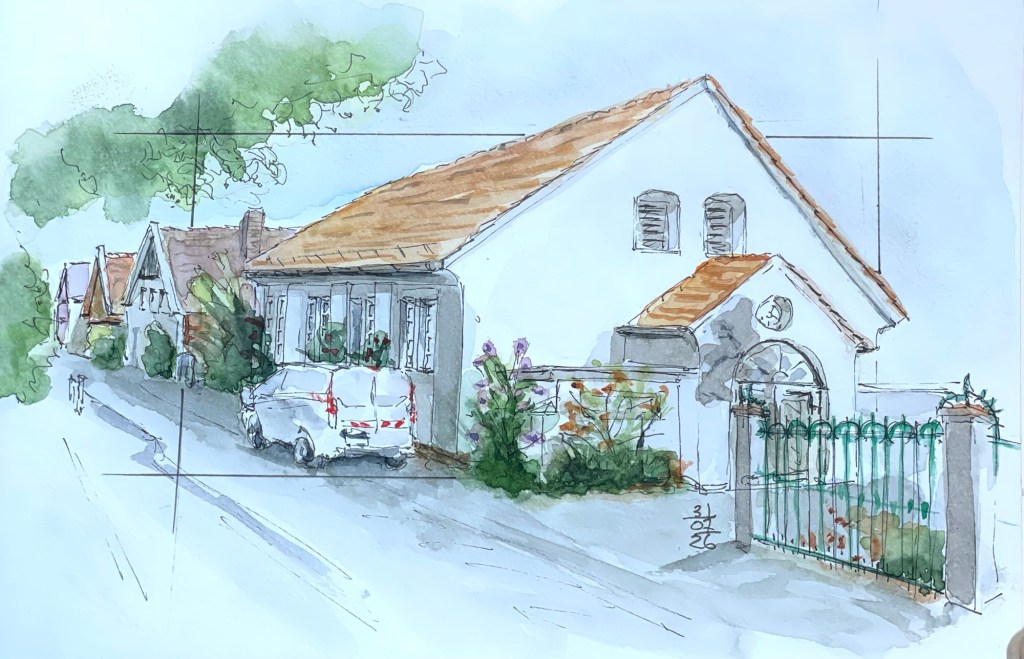
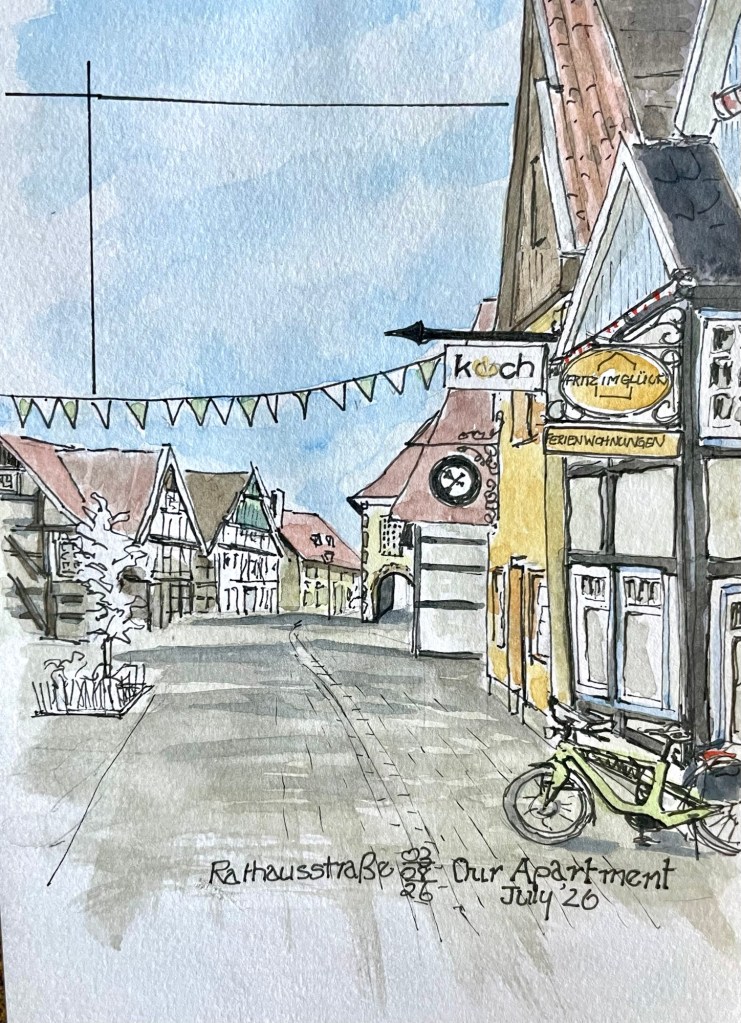
So …. Back to Rietberg. Our apartment is on the Main Street (Rathaus Straße-Townhall street) The Rathaus is a truely magnificent building: The zig zag element on the building facade is the stair well. Building an external staircase as an architectural feature rather than a back-door afterthought really makes a statement!

Das Rathaus ist wahrlich atemberaubend. Das Zickzack-Element an der Fassade des Gebäudes ist das Treppenhaus. Wie wunderbar, dass die Treppe ein architektonisches Element ist und nicht bloß ein nachträglicher Einfall.

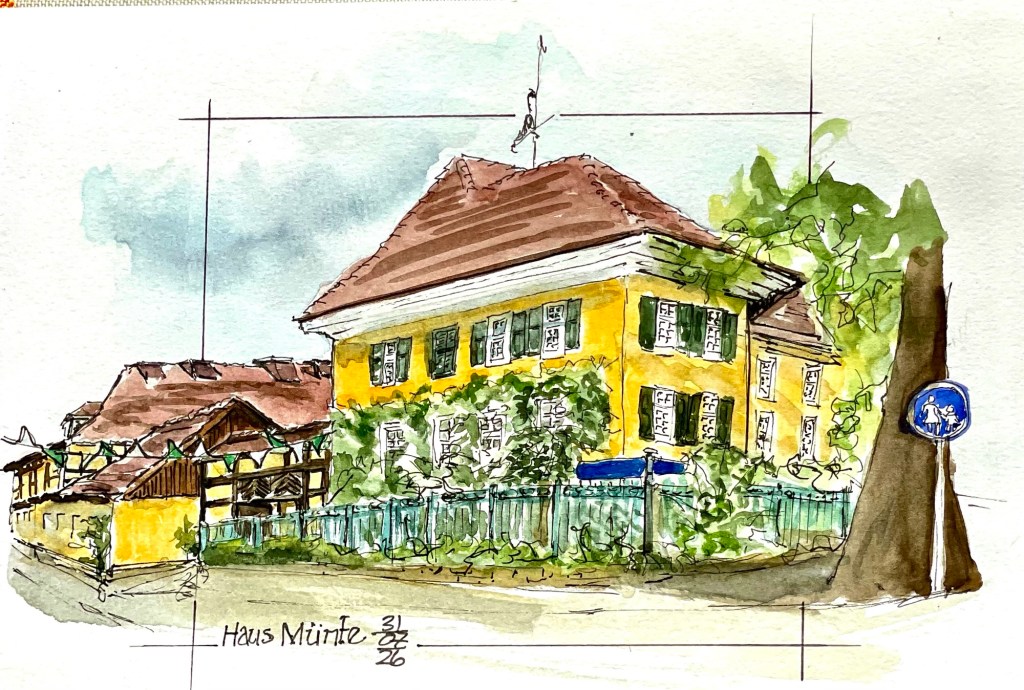
Across the street from the Rathaus is a beautiful half timbered (Fachwerkhaus) house that has been in the process of renovation for two of the four years I have been visiting. It is now a prestigious café with an outdoor garden area too. The small blue door at the bottom left is a regular door entry. It gives you a sense of the dimensions of this huge home built in 1653, a few years after the 30 year war that devastated this part of Europe. The yellow building behind houses an art gallery that features work by Angelo Monitillo who welds metal „scrap“ into magnificent sculptures. Pegasus is outside!

Café Münte. Dieses wunderschöne Fachwerkhaus wurde 1650 erbaut. Als ich Rietberg 2022 zum ersten Mal besuchte, wurde das Haus gerade restauriert. Heute ist es ein stilvolles, gemütliches Café in dem man verschiedene Kuchen und Kaffeespezialitäten genießen kann.

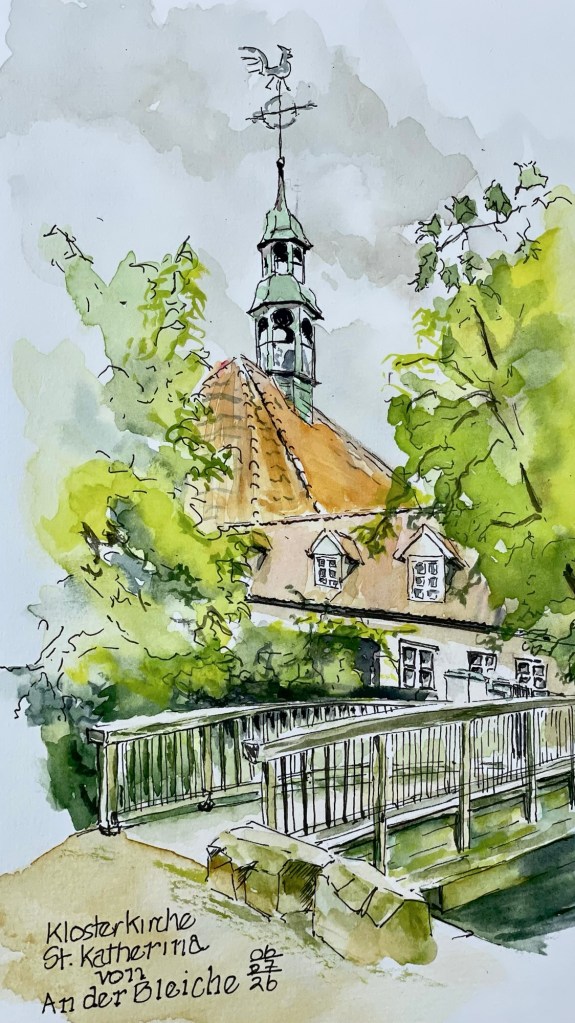
The old town of Rietberg is surrounded by a modest moat based on the River Ems. There‘s a delightful treed allée that we walk in the evenings to top up our step count if necessary. At one point there is a striking view of the Kloster St Katherina steeple. In the 1800‘s and possibly before, the place where. Iowa’s standing was a meadow where people bleached their sheets in the sun.

Ein Blick auf den Kirchturm über den Wassergraben hinweg; im 19. Jahrhundert bleichte man auf dieser Seite des grabens die Bettlaken.

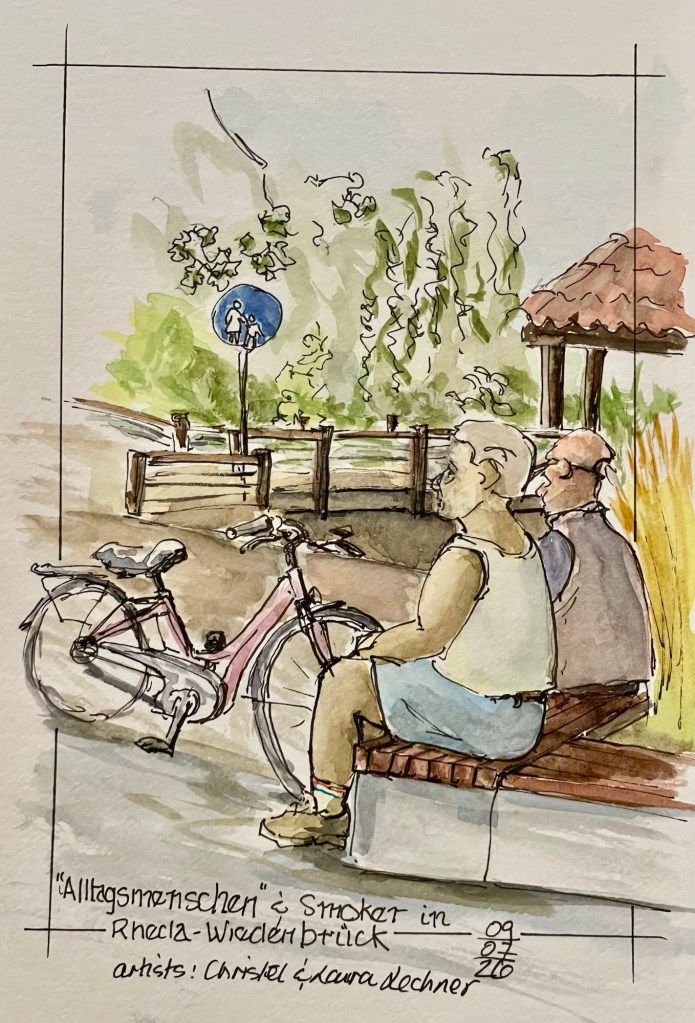
Last but not least, this last sketch celebrates many of the wonderful concrete sculptures made by a Mother/daughter pair that are found all over this area. The sculptures are larger than life and represent people in everyday activities. In this case, Andreas and I had stopped for an ice cream and I could sketch the rounded young man sitting on the bench. As I started, an older man rode up on his bicycle, sat next to the sculpture, smoked a cigarette and left. The poignant part of this story was the following day when we brought Siggy and Ingrid to the same ice cream place, the same man came and sat in the same place, smoked another cigarette and left.

Der Raucher und sein jüngeres Ich – eine Erinnerung? Der junge Mann ist eine betonskulptur. Während ich die Skulptur zeichnete, kam ein ältere Mann auf seinem Fahrrad vorbei, setzte sich,rauchte eine Zigarette und ging wieder. Das Bewegende an diesem Ereignis war, dass er am nächsten Tag wiederholte.

Settling into life in Rietberg and celebrating Schützenfest

Ihave been traveling to Europe with Andreas for the past four years and Rietberg has become my home from home (ein zweites zuhause). After bicycling in the Netherlands and each year discovering new vistas to capture the imagination, its nice to come „home“ to a familiar place, have the same bed to sleep in for more than a couple of nights and emerse myself into the local tempo. This year our apartment is in the center of the newly „pedestrianized“ down town core that is largely made up of half timbered houses built in, during and after the 30 year war in the mid 1600s. Our building is itself a restored and renovated half timbered house. We have the ground floor suite with a large kitchen/living room opening onto a small enclosed patio garden. Like most houses in Germany this also has no air conditioning so heat management will be a challenge as the house is orientated in a west-east direction. The bedroom faces west and the living room east. At least we are on the ground floor and do not have to deal with over heating under the roof. But I am getting ahead of myself….

When we first arrived back in the home town area we stayed for two nights with Friederika, Andreas‘s next youngest sibling. It was at the peak of the heat wave so we spent those first couple of days very quietly. FIFA kept us all company!.

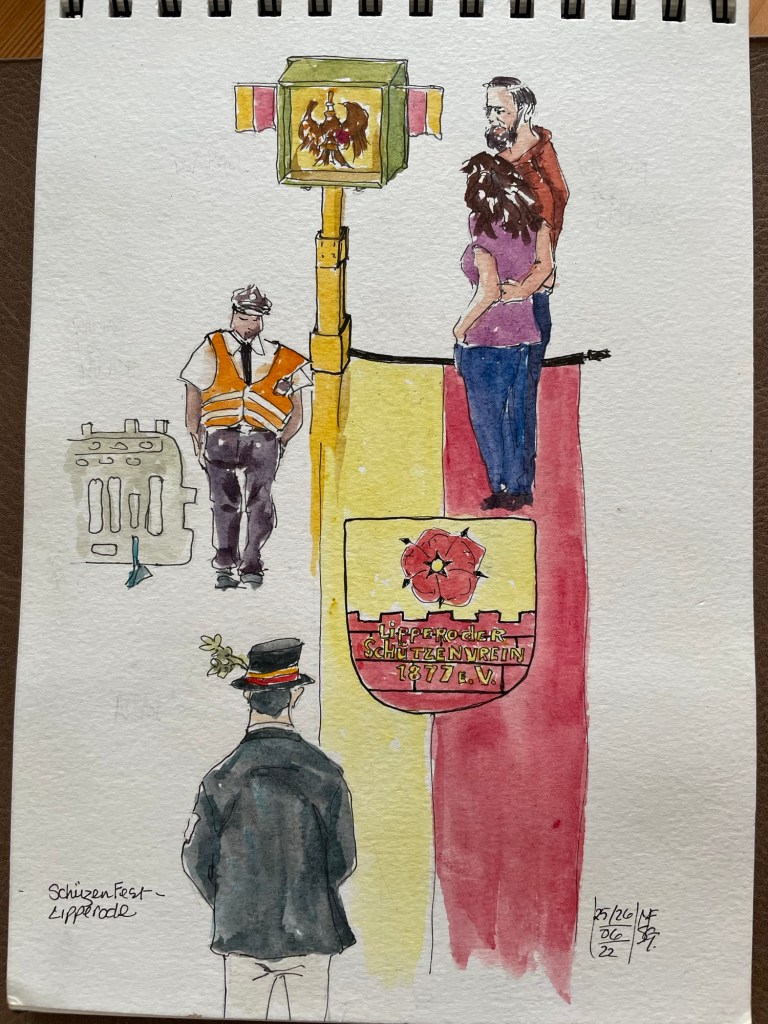
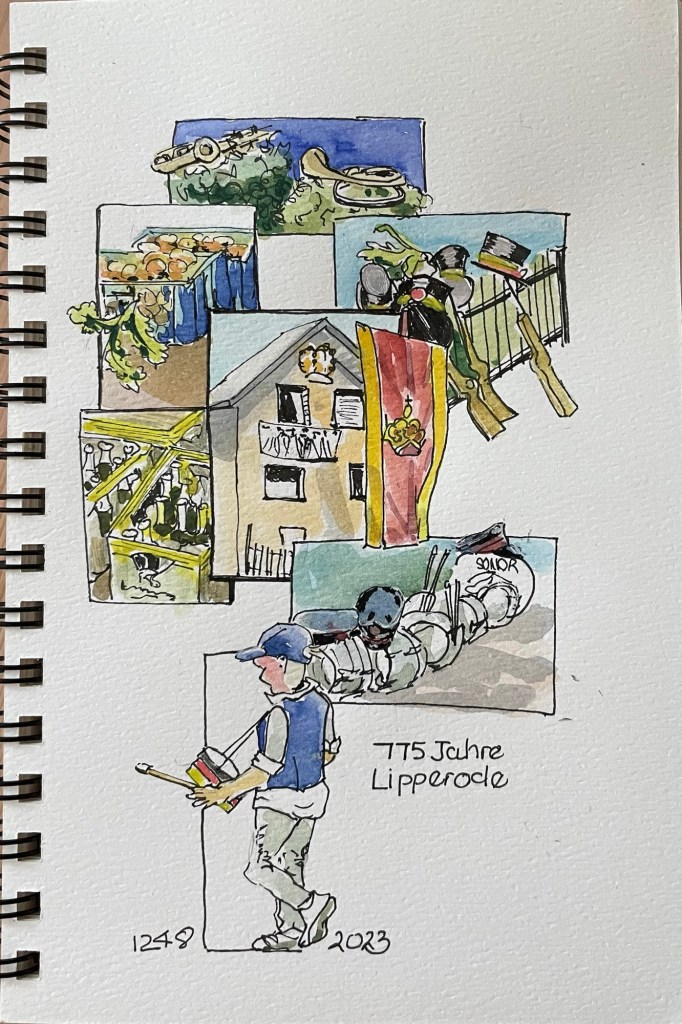
On Sunday we moved into the apartment and Monday it was off to Andreas‘s childhood home, Lipperode to observe the near final event of the local Schützenfest. This is a multi day festival that replicates itself in all the towns, large and small in this part of Germany. It has its origins in the 14th century when towns and villages needed to recruit local militias to protect the town and inhabitants from marauders.Tradition has it that at one time a man shot an eagle that was attacking a child. Hence the culmination of the long weekend is a ceremonial „Vogelschießen“ (Bird shooting) contest. The „bird“ is a wooden Eagle mounted high on a target board. The contest is highly ritualized and involves turn taking using a rifle mounted on a shooting frame that restricts the scope of movement of the gun. Within the bird itself are special target areas that when shot off triggers cheers and an opportunity for one or more of the brass bands to give a rousing rendition of one of the many lively marching tunes. It’s also an opportunity to run to the beer stand and refill the glasses. This event happens on the last Monday in June in Lipperode. It is preceded by weekend events that include marching bands that wake up the community on the first day, honor ceremonies at the cemetery to commemorate war time losses, street marching with marching bands that move around the village „Picking up“ the current Schützenfest officials and bringing them to the central festivity hall. All of this is accompanied by neighborhood fellowship and beer drinking. A couple of years ago I was able to see one of these parades. The marching band arrived at a house all decked out with garlands and flags indicating the residence of the current Schützenfest king and queen. As soon as the band arrived and finished it song, the band an attending marching squads dissolved into the garden areas and dragged out crates of beer. As the participants awaited their refueling, speeches were offered acknowledging the current King and Queen. On the word from the Company leader the band and marchers were dismissed and the beer was quickly consumed at the Royal front door. In relatively short order the band and marchers quickly reconvened to march to the next „Royal“ household and the process was repeated. Within minutes, the neighbors who were not marching swooped in to clean up bottles and within 20 minutes everything was cleaned up as if nothing had happened. At some time in the afternoons there are full gala parades with smartly dressed men in their uniforms (in Lipperode its a black jacket, white shirt and pants and a black top hat. The hat has a yellow and red band around it and marchers also have a yellow and red sash). The women are dressed in beautiful ball gowns that are purchase new each year. Later in the evenings there are balls (I’ve not been to those as bicycle gear is not de rigueur).

Today was the first day quietly at home, getting groceries, visiting one of Andreas‘s other sisters, Sabina and husband Freddy, and trying to expand my German vocabulary using a multisensory approach… no not wine this time:

I was trying to remember the word for tap water. Turned out to be more of an education than I expected

Tap water has at least three words: the common one: das Leitungwasser (literally pipe plumbing water); Gänswasser (geesewater, because that is what they drink) and Kranwasser (Crane water, presumably because the faucet looks like a crane)

Botanical garden, storm damage and returning to home base in Rietberg

Just as we were leaving Groningen, we saw the canal bridge open and a beautiful modern version of a traditional flat bottom Dutch sailing boat passed through. It appease to be a “Lemsteraak (Visserman)” design with the distinctive low profile living quarters tucked below the flat foredeck. If any of you are tempted, I found a link to a company that can design a racing version of one of these beautiful vessels: hoekdesign.com. Happy sailing and don’t forget to invite me on the inaugural sail ;).

Our next stop was just east of Groningen in Westerbroek. The most striking thing about this area was the amount of ship building going on. Just down the road from our hotel we could see a huge transporter ship being built. Again with Google help it turns out that we were on a historically significant European maritime hub. The Winschoterdiep Canal stretches from Groningen, through Westerbroek to Hoogezand. It was initially built to transport peat in the 16th century. Interestingly the ship yards in the area are working together under the umbrella of The Green Maritime Coalition to pioneer zero-emission commercial shipping. It would take me too long right now to dive into the realities of this, but once again I am struck by the profound innovative spirit of Netherlanders. We missed it this year, but hopefully we will give ourselves a little more time for this area next year and visit the living museum “Historische Scheepswerf Wolthuis” in Sappemeer. Volunteers apparently demonstrate forging and woodworking associated with the traditional Dutch iron hulls.

Our hotel for the next two nights was the elegant Vand der Valk…with air conditioning! The weather was starting to warm up and having a cool place to chill was really appreciated.

The following day we took a short bicycle ride to Hortus Botanicus (botanical gardens in Haren). Its centerpiece is its Chinese garden, which is one of the few Ming Dynasty Chinese gardens built outside of china using Chinese materials and designed by Chinese garden designers. To my great surprise one of the others is in Montreal which we visited last year.

I spent most of the time sketching a delightfully small bridge over a Lilly pond. An enormous carp kept distracting me as it appeared to be trying to “walk” or eat its way across the Lilly pads – bizarre! Andreas managed to get some superb photos of these Lilly pads and I’m looking forward to trying to capture them in watercolor when I get back to AZ and have access to a full palate of colours and proper watercolor paper.

Towards the end of the afternoon we enjoyed a glass of fresh ginger tea looking over another pond of lilies. A pair of coots kept us entertained with their nest building antics. We assumed that the female stayed on the nest arranging the materials her partner brought her from the pond. At one time he wrestled mightily to pull up a prized leaf. In the process the stalk became rather chewed up and slimy looking. He paddled it proudly back to his mate. Initially she seemed quite pleased until the slimy stuff ended up all over her feathers. She managed to trim the slimy stalk off and discard it and then spent the next 5-10 minutes preening and cleaning up. The male disappeared… What a joy it is to be able to suspend reality and emerse ourselves in the realities of a couple of coots…. OK I’m waiting for your comebacks on that one.

The next two days we made a leisurely trip to Leer, Germany, overnighting at the border town of Bad Nieuweschans. It is on this section that we saw the full effects of the storm from a couple of days before. It looked as though a strange tornado had ripped through the area. Selective trees were downed but neighboring ones appeared untouched. Some industrious folks had been out clearing the roads and bicycle paths except for one:

As we approached Leer, I once again started feeling a little anxious about cycling on city streets looking for our accommodation. I needn’t have worried. The route was pretty straight forward. We stopped for lunch before figuring out exactly where our accommodation would be for the night. We spotted an unusual lunch place that also sold hand made shoes from Portugal, the Schuhcafé. The tasty table d’hôte featured an open faced toasted sandwich with goat cheese, chorizo walnuts and a lavender-honey dressing with oregano and balsamic vinegar. Finding gastronomic treasures like this is one of the joys of meandering. We stayed there for quite a while and I was able to sketch the upper part of the very impressive town hall building that was just infront of a very informal maritime museum.

One of the things that I learned that day was that England is not the tea capital of the world, not China or India either. It’s here in Leer. They have a tea ritual that involves rock sugar at the bottom of the cup, hot black East Frisian tea is poured over the sugar causing it to crack and then heavy cream is poured on top to create a cloudy layer. It sounds a lot like how we made Irish coffee in England! Unfortunately the museum was closed the day we arrived. Another item on the list for next year.

Making funny signs seems to be popular in this part of Europe. Leer had a couple that are worth keeping.

The last surprise was our accommodation. It was stunning and would be a fantastic place for a multi day stay. Charming, well equipped, with a view onto the Ems.

That’s all for now. We are back in our home base town of Rietberg. We’ve just moved into the apartment that will be home for a the next month.

Retuning to the mainland and heading east towards Germany

Leaving Harlingen was pretty easy. We found the dyke bicycle path quickly and could enjoy more of the Waddenzee. Somehow Waddenzee sounds so much more romantic than mudflats! Every 6 hours tidal action reveals the shallow mudflats. Needless to say the bird life continues to be amazing. In addition to birds, sheep and public art dot the landscape.

Most of the time the sheep were on the side of the path. Every now and then a group would decide to hold a heads-down meeting in the middle of the road and were not to be disturbed.
Most of the sheep had not yet been sheared and were already showing signs of heat stress despite the temperatures had not risen to what was forecast for a few days hence.
The curve and camber of this section of the dyke felt like we were going to cycle into the wide blue yonder. The breeze was wonderful and despite no shade, as long as we kept moving, traveling was pretty heat stress free for us.

Finding interesting places to stop for a bite is another joyful adventure. On this day we found a place tucked in behind the massive dyke workings. Andreas tried what turns out to be a local dish: “Groningen mosterdsoep” – Mustard soup. It is a rich soup with a roux base. The aromatics are sweet leeks, onions and garlic. Heavy cream or crème fraîche gives it its silky feel. It is garnished with Smokey bacon. The mustard is stone ground coarse unsweetened Dutch mustard. A bit heavy for me, but I would like to try making it this coming winter time back home in AZ. I opted for their vegan vegetable (zucchini) soup with coconut milk. It was tasty but for my taste I would have added a little more coconut milk to increase the silky feel. Next door to this charming restaurant, which was clearly on the locals’ bicycle route, a mother/daughter (I’m guessing) team was painting the upstairs windows. It very much reminded me of my teenage years when, for a few years, I loved to get out the ladder and paint windows. I remember being delighted by transforming the tired, chipping paint with a bright new coat with crisp lines against the windows.

That night we stopped at Dokkum. Its place is burned into my memory as an example of when local knowledge is imperative when Google is out of its depth. The “hotel” was distributed across several buildings around the church square. Our particular building was new, but despite that – still no air conditioning. We checked in at another building that had a completely different name from that on Booking.com. We probably bicycled past the front and the back before we found it! After a bracing day of adventure in the wind and sun we could have done without the labyrinth search.

None the less, once we were checked in and acknowledged the stylized OysterCatcher art on the bedroom wall, we went in search of something for supper. Bistro chairs on the sidewalk with small groups of people enjoying the evening was a clue that we might have found our refreshment for the evening. Sure enough, Pizza and a bottle of Primitivo (a traditional wine from the Puglia region at the “heel” of Italy and the forerunner of the Zinfandel of California) did the trick. Andreas is a wealth of information regarding wines and over the past four years my palate has become more sensitized to the nuances of wines. I’m still very far from being able to recognize wines by their taste, but I enjoy exploring the aroma and taste notes as they change from first opening the bottle to draining the last drop. Primitivo was no exception. We also had a charming waiter from Italy who was excited to tell us that he had cruised around many of the coastal US areas.

The next morning we headed south east towards Groningen. My version of how we should get there took us on a bit of a detour, but fortunately our discussions about where we were were overheard by someone in their garden She popped her head over the bush fence and helped us get back on the more scenic canal bike route. The detour turned out to be not a complete waste of time. The little town of Eastrum was preparing for a weekend Western event. Big posters of saloons and western scenes dotted the Main Street.

As we turned inland, the vegetation and architecture changed. The canals were lined with Burdock, and some of the farmhouses took on truely mansionesque proportions.

These massive burdock leaves really captured my imagination. The morning sun silhouetting the veins and giving the leaf edges a golden hue mirrored the larger than life sensation of being alive on a beautiful morning, riding the canals at a meandering pace and being able to soak in the colors and aromas of the area.

A typical loch scene. This is where two dyke canals join and form the single Dokkumer Djip that flows into a large dammed lake the Lauwersmeer that opens into the Waddenzee. The entire area around the Lauwersmeer is a National Park.

This area is known for its Kop-Hals-Rompboerderij (head-neck-rump) farmhouse design. The design features the living quarters (head) and massive architectural barn (Rump) connected by a smaller lower building (Neck). The neck housed the farm working area for butter making, churning butter and making cheese. It is said that the silhouette looks like a sleeping cow.

Another interesting construction detail that I have noticed over the past few years is the combined use of thatch and clay tiles. Thatch is often used over the main section of the barn for its insulation qualities. Also the source material is very much locally available. It requires more maintenance and doesn’t last as long (25-40 years). The clay tiles are used over living areas as they last for decades (50-100 years).

The barn (Rump) is huge to accommodate all the livestock of the farm when North Sea storms blow in. It also houses all the animal feed. Thanks to Google, I learned about a particularly intriguing part of the barn architecture, the Uilenbord (Owl board). It’s the decorative triangular structure on the ridge of the roof that provides protection from wind and rain for owls that hunt mice and other small animals that are associated with farm life.

The house in the picture above epitomizes all of these features. In older structures of this type that I saw, the barn would be at least 2-3 times longer than the house. Later in the day I saw permutations where the neck disappeared and the house became a solid 2-3 story affair with a grandiose entrance. It seemed as though the sleeping cow‘s head has grown to engulf the neck. Perhaps these places have evolved into „business retreats“ for team building exercises??? Despite on going reduction in interest in local farming, this area seems to be maintaining its local feel and there appears to be great pride in maintaining and restoring these magnificent iconic structures. I sincerely hope bigAgro does not come in and destroy this superb ecosystem.

By early afternoon we were getting close to our next overnight stop. We were anxious to get out of the sun for a while and enjoy a coffee and lunch. Stopping spots were thin on the ground this day but we did eventually find a charming bakery that sold lunch treats along with loaves.

We rested up at this bakery for almost 2 hours. They had a small sitting area outside with an umbrella for shade. It was delightful to see the local dynamic that probably plays out daily. I couldn’t understand any of the Dutch but I did pick out a parting sound that was made between people who know each other well…. Sort of a sung ooh hoo not unlike the British “Cheerio” again with the help of Google AI I think what I heard was “Ajoos, tot snel” where Ajoos is two syllables, the first ah is lower pitched that’s the second “yoos” and it is said in a playful way.

We ended our day in the town of Zuidhorn – yes another small town with open pedestrian areas, traditional architecture, cobbled streets…

I was pretty tired that night and was looking forward to a good night’s sleep…. Not to be the case. The area experienced a massive lightening event that went on for hours accompanied by very high winds. The Royal Netherlands Meteorological Institute recorded over 188,000 strikes across the Netherlands with the area east of Groningen experiencing the worst of the storm. When we got up the next morning I was really wanting to stay put another night as I felt I needed to catch up with some rest. The trip was so full of new experiences I think my body just needed a break from all the excitement. Unfortunately there was no room in the Inn but we did manage to secure a room for a couple of nights to the east of Groningen. We had been anxious about cycling through a major Dutch city as our experience seeing the crowded bicycle lanes in Amsterdam really terrified us. We shouldn’t have been so frightened. There was a wonderful bicycle highway right into the downtown area. Maybe the storm had kept the bicyclists away. We did not know at that time how much damage was to the east so we thought that this was a typical Saturday morning in Groningen. I must admit we fell in love with the youthful vibe of the city. We found a lovely cafe with trees giving shade by one of the major canals and enjoyed watching the city come to life, complete with a modest Gay Pride parade complete with pink tractor. There were plenty of party boats floating the canal. Some clearly local football clubs with guys swilling beer at 10:30am, others more refined more fitting to a bachelorette group sipping Aperols and munching bitterballlen. The funniest thing of all was seeing two fisherman float by reclining in what appeared to be inflatable sofas. The “sofas” were kitted out with a fish finder and other fishing accoutrements. Propulsion was self made by virtue of fluorescent green flippers

The view from our coffee pause cafe wit the Gay Pride parade crossing the canal bridge

Well that’s all for now… the next episode will cover our arrival back into Germany